Today we are announcing FieldFoundry
FieldFoundry is the second product in the KissanAI portfolio. The AI Command Center for agriculture, built for North American commercial production. What it does, why we built it, and what 'context fragmentation' means when you try to fix it.
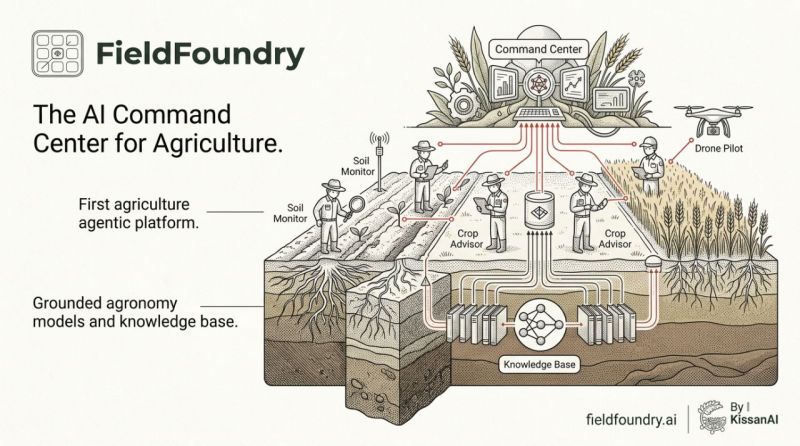
Today we are announcing FieldFoundry.
FieldFoundry is the AI Command Center for Agriculture. It is built for large-scale commercial production systems in North America, and for the people who actually run them: agronomists, retailers, farm operations teams, and ag enterprises whose work is to make decisions across hundreds of fields, thousands of growers, multiple seasons, and an avalanche of half-organised context.
The phrase we kept using while building it was “context fragmentation.” It sounds abstract. The daily version is not.
A season starts in six different systems
Agriculture runs on context, and most teams still rebuild that context from scratch every season.
Look at how an agronomy team starts a field season. They have grower notes from last year in a shared drive somewhere. They have scouting reports in a different tool. They have product labels and compliance PDFs in a third place. They have a few hundred photographs in someone’s phone. They have a Slack channel where a senior agronomist said something useful in February that nobody remembers in May. They have a CRM with grower contact info. They have, in the heads of the senior people on the team, the institutional memory of who farms what, what went wrong on a particular field in 2023, which grower will and will not take a phone call before 8am.
Each of these is a context fragment. Each is real. Each gets in the way of doing the next thing well, because reassembling them is more work than just guessing.
FieldFoundry’s job is to make that context continuous.
The product
FieldFoundry runs on three layers built into one product:
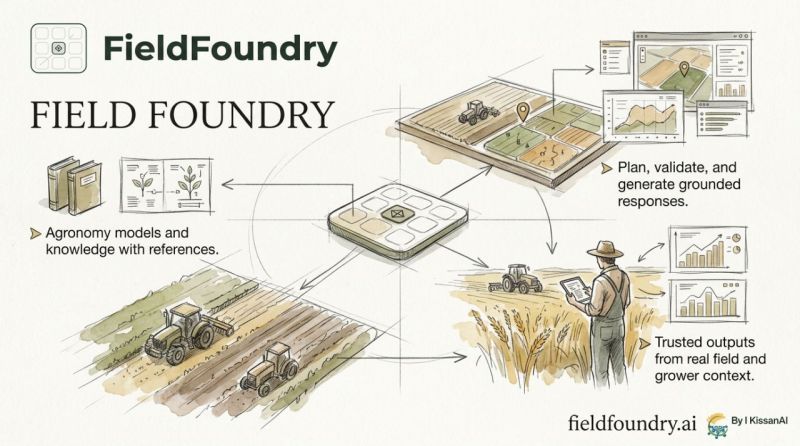
Grounded agronomy models with references. The foundation is a family of agronomy-tuned language models trained on crop labels, extension publications, applied research, and product compliance literature. When the system makes a recommendation, the recommendation links back to the source. Agronomists do not need to trust the AI. They need to verify the AI, fast.
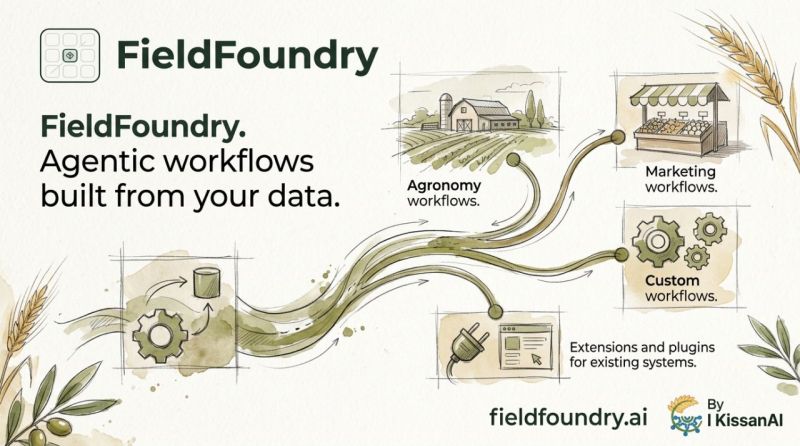
Agentic workflows built from your data. Agents specialise. There is an agronomy advisor agent. There is a marketing agent that knows your product mix. There is a compliance agent that knows your operating geography. And there are custom agents that teams build for their own workflows, from scouting summary generation to grower segmentation to deep research on a specific field problem.
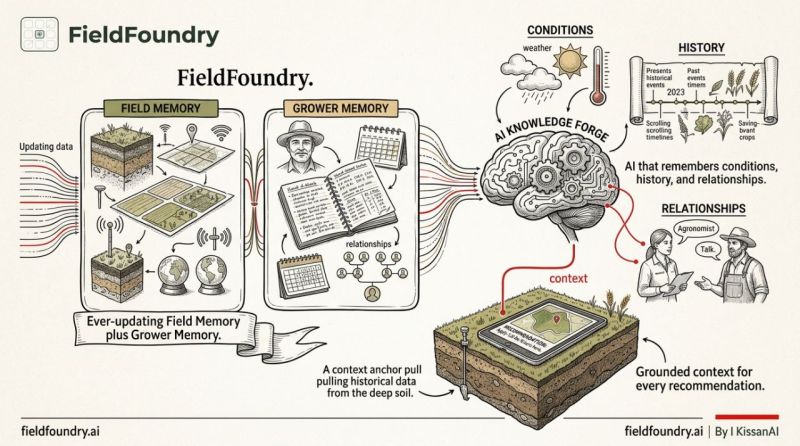
FieldMemory. This is the layer we are most proud of. Every conversation with FieldFoundry adds to a persistent memory keyed to a field. The agent that talks to your team in October about a sclerotinia outbreak on a specific field can recall, in March, when the same field is being scouted again, what the recommendation was, what was applied, what the outcome looked like. This is what makes the same agent, the same conversation, the same recommendation more useful in year two than in year one. Grower-level memory, the same idea scoped to the operator, is on the bench next; we are moving deliberately there because the privacy questions get sharper when the subject is a person rather than a field.
Who we built it for
- Agronomist advisors get more grounded recommendations because the model is keyed to the actual operating context of the teams they work with.
- Retailers get more repeatable team workflows because the institutional memory of senior agronomists lives in the system rather than only in their heads.
- Farm operations teams get more connected field execution because the context that drove last week’s decisions is still there for this week’s decisions.
- Ag enterprises get continuity across teams, seasons, and systems. The new hire in March 2027 will not be starting from zero, and the senior agronomist who retires in 2028 can leave without taking the institution’s memory with her.
Why North America
The agronomy services market in North America already pays for sophisticated software, and the unit economics of an enterprise contract plus per-seat licensing match the operating shape of the platform we are building. We have spent three years hardening agentic AI on the Indian smallholder problem, where unit cost is everything. Bringing that engineering muscle to a market that is willing to pay for sophistication, and that desperately needs the context layer, is where the team time goes furthest.
There is also a harder-nosed engineering reason: the harness we built for sophistication needs the hard problem of multi-stakeholder agronomy in commercial systems. FieldFoundry is where the agentic complexity lives; Dhenu, on the India side, is where the cost discipline lives. The two products keep each other sharp.
Two products, one research base
KissanAI is the parent company, doing the core research and engineering across models, data, agronomy nuances, and harness design. We ship two products:
- Dhenu Platform, the agentic platform for agribusinesses in India and emerging smallholder economies. We launched it last month at the India AI Impact Summit. It is voice-first and built for very low unit cost.
- FieldFoundry, the AI Command Center for agriculture teams in North America and similar large-scale commercial systems. It is built for sophistication and context.
They share the underlying harness, the agronomy methodology, and the muscle to build agriculture knowledge graphs from messy multilingual data. They are very different products on top of that shared foundation. We will write more about each as the platform evolves.
Early access
Early-access partners are onboarding now. The reference customers we are working with span agronomy services, ag retail, farm-management operations, and ag enterprise. We will publish case studies as the pilots mature.
If you run an agronomy team, an ag retailer, or a farm-operations team in North America and any of the above resonated, write to us at fieldfoundry.ai. We are taking a small set of design partners through the rest of the year.
Ryan, Chintan, Lokesh, and the rest of the team got the product to this point. Sachi, the AgTech Alchemy circle, Skyhaven Group, DeepRoot Strategies, and our early reviewers made us explain the product in the language an agronomy team would actually use. A fair amount of their feedback is now sitting in the workflow.
The first early-access partners are connecting their field histories now. That is where FieldFoundry starts.
Sources
- FieldFoundry · KissanAI KissanAI