What six weeks of farmer questions taught us
An early field note from KissanGPT: the language and question patterns we saw, what farmers expected from the product, and what those conversations taught us to build next.
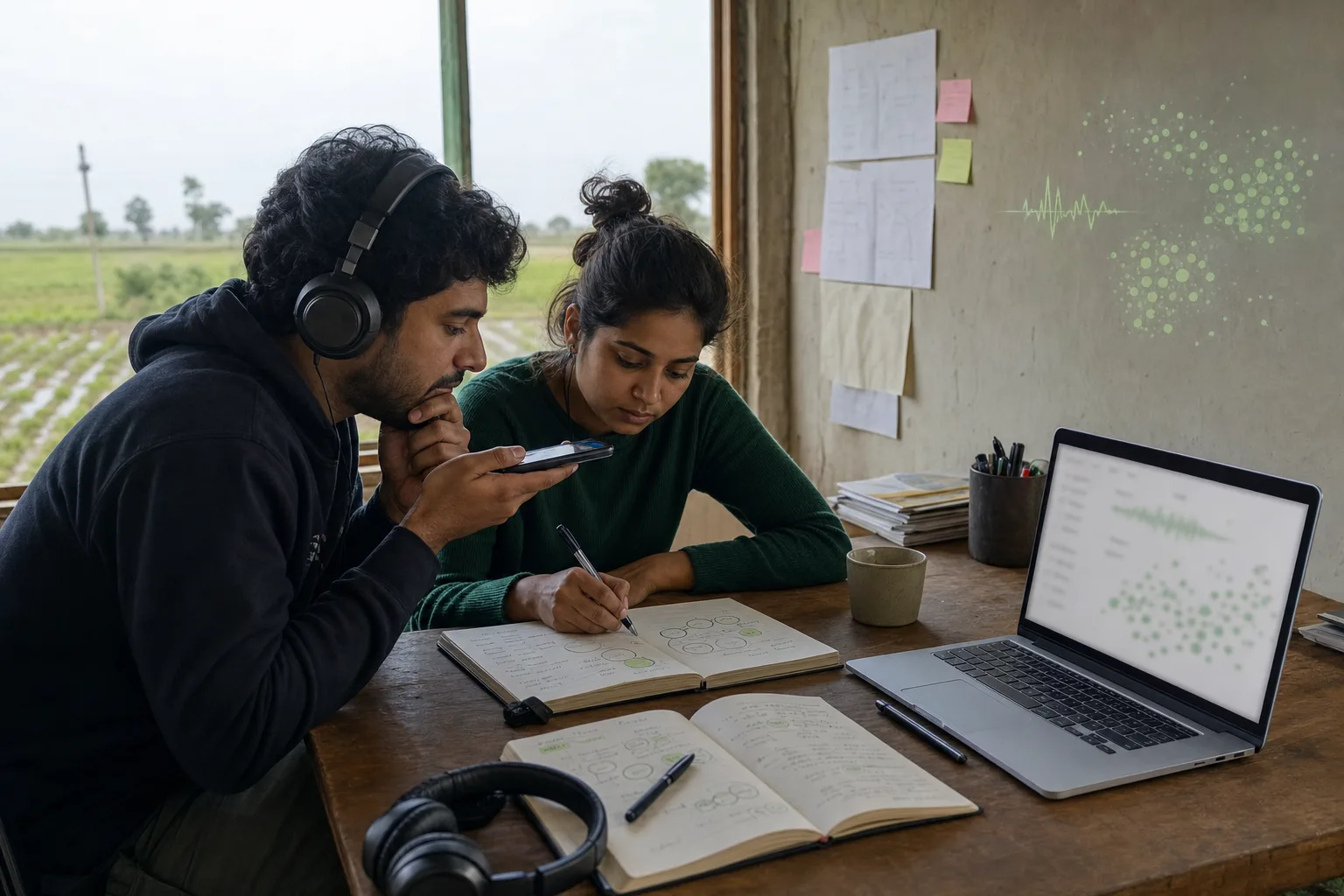
This post looks at KissanGPT’s first six weeks after launch. It took me another couple of weeks to work through the logs and write down what we had learned. During that early window, the product spread from a single web app and a tweet into farmer WhatsApp groups. By the end of the first week we had several thousand active users. By the end of week six we were past ten thousand. The important part was not the six-week milestone itself. It was that the conversations were already revealing patterns we could use to shape the product.
This is a field notes post, not an analytics post, so I am not going to lead with totals and growth curves. I want to walk through specific examples of queries, in the languages and dialects they came in, and surface what we are learning about who is using this product and what they expect from it.
The queries are more regional than we planned for
The launch product supports nine Indian languages. We expected Hindi to dominate. It does: about 38% of queries are in Hindi. What surprised us is how strongly the other eight languages show up. Marathi is at 16%. Gujarati at 11%. Tamil at 9%. Telugu, Kannada, Malayalam, Punjabi, and Bengali fill out the rest. Within each language, the dialectal variation is sharp. Vidarbhi Marathi looks different in our query logs from Pune Marathi. Coastal Andhra Telugu looks different from Telangana Telugu.
What this tells us, six weeks in, is that the demand for a non-Hindi farmer-facing AI is real and immediate. The product would have failed if it had been Hindi-only.
Operational questions, not curiosity
A small sampling of actual queries (translated, with the original language noted):
- Marathi (Vidarbha): “Kapsala paani aaj de ka udyatla deu?” (Should I water the cotton today or tomorrow?)
- Hindi (Bihar): “Aam ke pedh par ek ajeeb keet dikh raha hai, kya karu?” (There’s an odd pest on the mango tree, what should I do?)
- Tamil (Coimbatore region): “Vendaikai pasal-laye nan irukku, ena seyya?” (There’s a fungal-looking issue on the okra, what to do?)
- Telugu (Andhra coastal): “Nelarogyam baaga ledu, ye fertilizer cheyyali?” (The soil health is not great, which fertilizer should I apply?)
- Gujarati (Saurashtra): “Mungna phad par leelu rang chhe, ke shu thaay che?” (There’s a green tinge on the moong pods, what’s happening?)
- Kannada (Mysuru region): “Ee year ragi bele yavaaga haakali?” (When should I sow ragi this year?)
Nobody is asking “what is artificial intelligence.” These are the questions a farmer would put to the agricultural officer if the officer were available and the conversation was easy. The user has shown up with their actual decision-making in their actual language.
The early question patterns were already visible
This was an early, directional review rather than a clean analytics taxonomy. A single conversation could touch more than one theme, so the percentages below overlap and should not be read as a distribution that sums to 100.
Pest and disease diagnosis (28%). A symptom on a leaf, a pod, a stem, a fruit, described in the farmer’s own words, spoken or typed into the web app. The follow-up is “what should I spray” or “what to do.”
Government schemes and application status (roughly 30%). Eligibility, application status, required documents, and what to do when the process is unclear.
Weather-related questions (roughly 20%). Whether rain was expected, what a forecast meant for the field, and whether an operation should happen today or wait.
Sowing, planting, and irrigation timing (roughly 12%). When to sow given the monsoon, whether to water now, what variety to choose, and what spacing to use.
Fertiliser regime (10%). What to apply, when, in what dose. Often the conditioning is on a soil test the farmer either has or doesn’t have.
Market price queries (9%). What’s the mandi rate at the nearest market? Is the price likely to move? Should the farmer hold the produce or sell now?
There was also a long tail: animal husbandry, water-source problems, drip systems, post-harvest storage, and questions that did not fit a single category. The value of this early review was not a perfect chart. It was learning which context the product needed to ask for and which tools it needed to call before answering.
What the failures are teaching us
The most serious failure is regulatory. A farmer in Maharashtra asks about a pesticide that has been banned in the state. The model recommends it. The farmer’s question logs this as “answer received” but the answer is dangerous. We are now building a state-level regulatory layer that the model has to consult before naming any brand-level product. This was not in the original spec; the first six weeks of queries made it non-negotiable.
The subtlest failure is vocabulary. Farmers use regional pest and disease names that appear in no agronomy text: a Vidarbha cotton grower has a word for the exact caterpillar stage at which the spraying decision changes, a Tamil farmer has a name for a fungal symptom on okra that no dictionary carries. The model does not know these words. The existence of the gap was a surprise to us. We are building a regional vocabulary mapping.
And the most common failure is missing context. A farmer asks “should I spray for bollworm” without saying what growth stage the cotton is in. The right answer depends on the stage. The model defaults to a generic answer that is wrong if the farmer is in a stage where economic-threshold-based decisions would say “no, do not spray yet.” We are building a clarification-question layer that gets the missing context from the farmer before answering.
The next build is already taking shape
A few things came into focus this past month that were not as clear before launch.
Prompt engineering can patch some of the failures above. It does not fix the underlying gaps, so a domain model now looks necessary rather than optional. We are starting work on a purpose-trained Indian agricultural language model. We will say more when there is something real to show.
Voice is confirming itself as the primary interface. We launched with both voice and text, and voice is winning by a factor of three. The audio chain is the engineering investment that pays off.
The deployment partner relationships are going to define the next phase. We are getting requests from agribusinesses who want a version of KissanGPT they can deploy under their own brand, integrated into their existing farmer outreach. That is the platform direction, and the shape of it is forming.
And the user, it turns out, is patient enough to teach the model. Farmers send follow-up corrections. They describe the same symptom a second time in different words. They give feedback that we get to read because we are paying attention to query logs. The relationship is reciprocal in a way I had not expected: the product gets better because the user is willing to teach it.
At launch this was a tweet and a web app. Today it is a conversation with ten thousand farmers, in nine languages, about specific operational decisions that we are getting better at helping with. The product is nowhere near finished, but it is finished enough to learn from, and the learning is the part that compounds.
The most useful messages are still the corrections. A farmer repeats the symptom, changes one word, and shows us exactly where the product lost the meaning. Those corrections are as useful as anything on the roadmap.
Sources
- KissanGPT · KissanAI KissanAI