KissanGPT: a small experiment, in Gujarati
A career in Silicon Valley, an evening in Surat, and a bet that the farmer my father trained should be able to ask a phone questions in his own language. This is how KissanGPT started, what we built first, and what we learned in the six weeks after the launch.
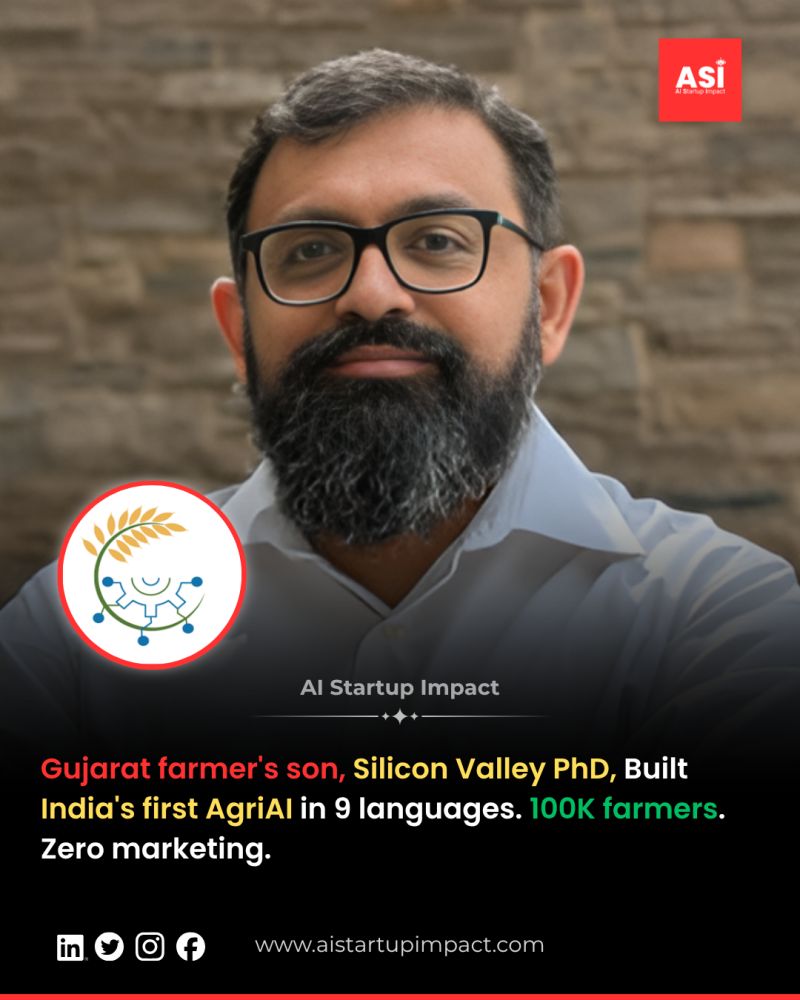
I grew up watching my father farm a small plot in Gujarat. He read the soil better than any sensor I have ever shipped. He could tell from the colour of a wilted leaf what the next week of weather had been. The thing he did not have, the thing nobody in the village had, was a way to ask a question of someone who knew something he did not.
When I built my first chatbot in California, I was thinking about him.
For most of two decades my work has been computer science, in California, on systems that talk to systems. I have co-founded three startups in the Bay Area. I have shipped knowledge graphs, semantic systems, ML pipelines for industries that have nothing to do with the field my father stands in. Through all of it the question kept returning. Why does the farmer who grows what India eats have less access to working knowledge than the engineer who builds the API he will never use?
In November 2022, ChatGPT launched. Two days later I was asking it questions in Gujarati. The answers were not bad. They were also not for him. The model wrote in tidy English. It had no sense of a Surat field in March, or what a watermelon farmer in Junagadh should do when his vines wilt three weeks before harvest. It did not understand that “phool” in his mouth is a flower but in a market report is the early bloom that signals price drop. The model spoke a confident kind of nothing.
So I started building.
KissanGPT, which we launched on Pi Day, March 14, 2023, is a small thing. It is a ChatGPT and Whisper wrapper that listens to the farmer in his own voice, transcribes it into the language the model can reason about, runs a prompt that puts the question into agricultural context, and reads the answer back in the same voice the question came in. Nine Indic languages on launch day. Gujarati. Marathi. Tamil. Telugu. Kannada. Malayalam. Punjabi. Bengali. Hindi. Hinglish for the in-between.
The launch was a single web app and a single tweet. Within the first weeks, thousands of farmers had used it. By week six, the press in fifteen languages had picked it up, from Amar Ujala to TV9 Gujarati to ABP Bangla. None of the reasons we expected. People did not write to us about novelty. They wrote with questions: which mango variety to graft this year, whether to spray for thrips before the storm, what the mandi rates were doing in Vashi.
A few things are clearer to me now than they were in November.
The language model is only part of the product. The audio chain is what lets the farmer reach it. The model under the hood matters less than whether the farmer can speak in the dialect his mother spoke. A Konkani fisherman calling about lemongrass cultivation will not type or switch keyboards. He will press a microphone and ask. Every product decision in this space ought to begin there.
The wrapper also matters more than I expected. Generic models can answer almost anything badly. A small wrapper that knows the month, the user’s location, the crop, and this morning’s mandi rates can answer one thing usefully. It is not the flashy part of the demo. It is the part the farmer notices.
The hardest lesson is the distance between an early-access product and a deployable agricultural assistant. KissanGPT is only the first thing. We still need to train a domain model, curate a knowledge base, harden the voice pipeline, reach scale, honour the price point, and build trust with everyone around the farmer. That includes family members, agriculture officers, retailers, and the village uncle whose advice already carries weight. Each part is a serious body of work. We have just started.
Please use it. Tell your relatives in the village to try it, and tell us when it answers badly. We listen.
For the first time, the phone already in a farmer’s pocket can take the question in his own language. That is enough for a first release.
Sources
- Indian Farmers' ChatGPT, KissanGPT · Analytics India Magazine (12 Apr 2023) News
- From fields to screens: KissanGPT, the AI chatbot helping Indian farmers · Business Insider (13 Apr 2023) News
- Meet Indian Techie Who's Transforming Agriculture With Kissan GPT · Sputnik India (27 Apr 2023) News