Introducing KissanGPT: the first voice-based vernacular AI for Indian farmers
Today we are releasing KissanGPT, a voice-first, multilingual generative AI copilot for Indian agriculture. First of its kind in two ways: voice as the primary interface, and Indic-language support from day one.
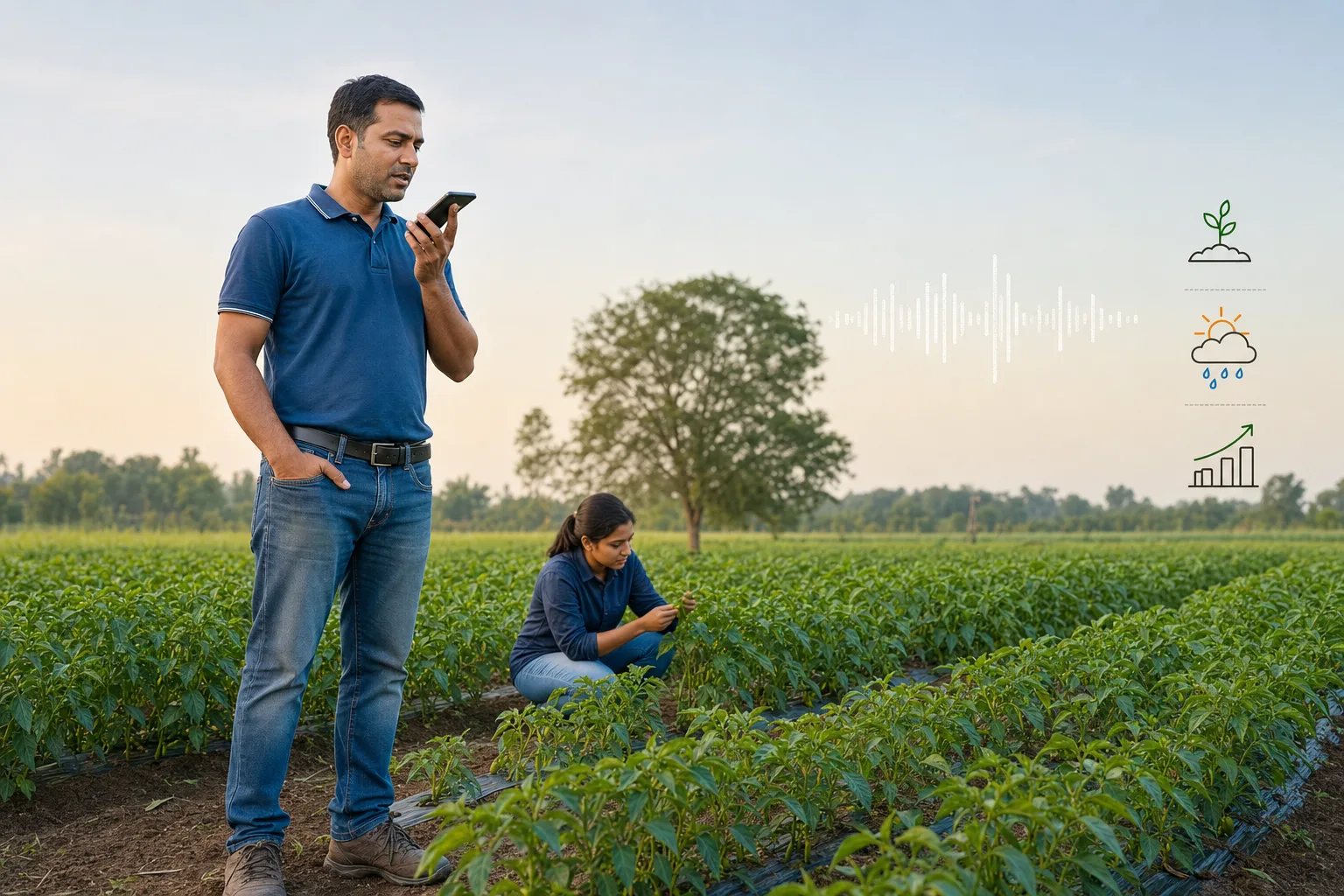
Today we are releasing KissanGPT, a voice-first generative AI copilot built for Indian agriculture.
This is, to the best of our knowledge, the first product of its kind on two counts at once. Voice as the primary interface, not chat, because the farmer who needs this most often cannot read. And Indic-language support from the first day, not as a v2 promise, because a tool that only works in English does not reach the farmer the tool was built for.
What KissanGPT does
A farmer opens the app, speaks a question in the language they are comfortable in, and gets a contextual answer back in the same language. The question can be about which crop to plant in the soil they have, the right time to sow given the current weather, the pest they noticed on a leaf this morning, the fertiliser dosage that fits the plot size, or what their produce is likely to fetch at the nearest mandi this week.
Nine Indian languages are supported in this first release: Hindi, Marathi, Gujarati, Tamil, Telugu, Kannada, Malayalam, Bengali, and Punjabi. More are on the roadmap. The voice pipeline handles spoken input and produces spoken output, so the interface does not assume literacy.
The knowledge that powers the answers is curated from agricultural research universities and extension publications, not scraped from the open web. A farmer asking about late blight on a tomato crop in Maharashtra should get an answer grounded in the extension manuals their local KVK actually uses, not a generic answer that may name a pesticide their state has banned. That curation is the part of the product that took longest to build, and the part I am proudest of.
Why this matters
There are several hundred million farming households in India and somewhere between sixty and a hundred thousand active agricultural extension officers. The math does not work. The average farmer almost never speaks with an extension officer in any given growing season. The advice they act on instead comes from the neighbour, the local input retailer, a state-channel television program, or memory. Some of that advice is excellent. A lot of it is wrong in ways that cost a season.
The thing that changed in the last six months is that the underlying language and speech models finally became good enough at Indic languages to make a usable product possible. Whisper handles speech recognition acceptably across the major Indian languages. Generative models can produce coherent agricultural reasoning in those languages with the right grounding. The remaining work is the work we have been doing: assembling and curating the knowledge corpus, building the agronomy-aware retrieval layer, designing the voice interaction loop, and shipping it on a phone that costs ₹6,000.
How it is built
The first version of KissanGPT runs on a stack that combines OpenAI’s GPT-3.5 and Whisper models with a domain-specific knowledge layer we have built up over years of working with Indian agricultural content. The retrieval layer queries a corpus of agronomy publications, university extension materials, and crop-protection labels. The voice layer handles the speech-to-text and text-to-speech sides in each of the nine launch languages.
The product runs on a smartphone in rural connectivity conditions: 3G-tolerant, with response latency tuned to be acceptable on the kind of network a farmer in Marathwada or northern Karnataka actually has.
What we are not claiming
KissanGPT is not the answer to every problem in Indian agriculture. It cannot fix mandi price volatility, and where a good agronomist is actually available, the farmer should keep talking to the agronomist. It will also give wrong answers occasionally, which is why we are deliberately conservative on anything it generates around brand-level pesticide recommendations: the cost of a wrong brand recommendation is a season’s crop.
What it will do is give a farmer asking a real question a real answer, in their own language, on the phone they already own, without waiting on a call centre and without depending on whatever the neighbour happened to say.
What is next
The release is live today. The walkthrough video above is also on our Titodi Agriculture YouTube channel, and it demonstrates the voice flow across the launch languages. Find me at @chheplo on Twitter and at linkedin.com/in/pratikdesai on LinkedIn.
Where does it go from here? What ships today is, plainly, a wrapper on generic models, and I am comfortable saying so. Eventually we want to train a language model purpose-built for Indian agriculture; that is an ambition we hold seriously, not a release date. Nearer term, we are extending coverage to the remaining major Indian languages and to crop-protection imagery (a leaf photograph being a more natural input than a verbal symptom description), and we are talking with agribusinesses and universities about deployment partnerships that get this to the farmers it was built for faster than we could manage alone.
KissanGPT is the smallest possible version of the future we are building. The next versions will go a lot deeper. But the smallest possible version is the one that ships today, and is the one I want a farmer in my father’s village to be able to use this evening.
Sources
- KissanGPT · KissanAI KissanAI
- Introducing Whisper · OpenAI (21 Sept 2022) Research