Pratik on Microsoft #ScaleUpThursday
Pratik joined Microsoft Reactor's #ScaleUpThursday for the season's closing episode: the KissanGPT origin story, why voice beats apps for farmers, and what it actually costs to train and serve a 7B agriculture model.
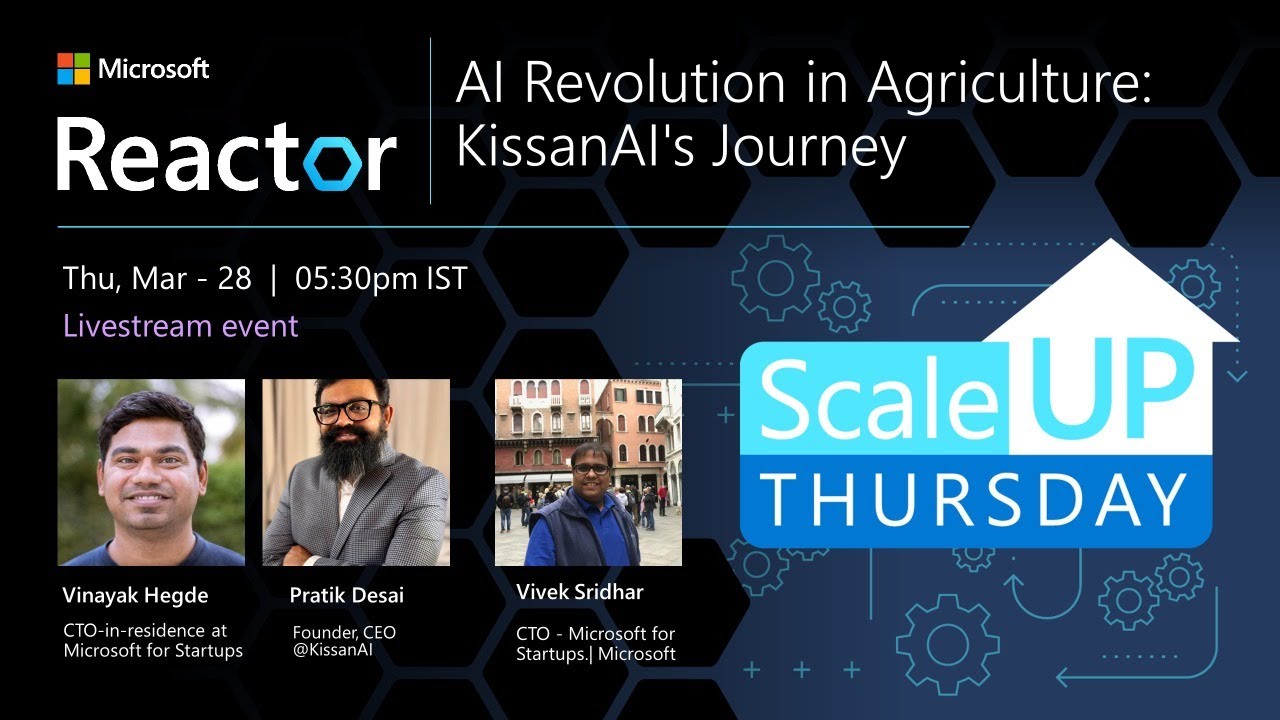
Half past five in the morning, Santa Clara time. That is when Pratik joined the Microsoft Reactor India team for the closing episode of this season’s #ScaleUpThursday, their recurring series on startups building applied AI. He opened with the obvious joke, that farmers start their day early anyway, and then the hour went where the series is at its best: the unglamorous parts of building. The episode title on the Reactor channel is AI Revolution in Agriculture: KissanAI’s Journey, and the hour is mostly that, the journey told in order with the numbers left in.
The arc will be familiar if you have followed us. A farming family in a Gujarat village, a PhD and a run of Silicon Valley startups in the US, then the pull back to agriculture. Pratik puts the reason plainly:
“I grew up on farms with my father, in a village… I have seen first-hand the troubles a smallholder farmer goes through.”
(Quotes in this post are lightly edited for clarity; the episode was streamed live and the captions are rough.)
The early experiments get proper airtime too: mapping 12 million farm plots in Gujarat that nobody would pay for, the farmer-storefront platform, and the lesson that carried into everything since, which is that Indian farmers will pay for inputs but not for software. What they will do is talk. The design brief for KissanGPT came straight out of that:
“We don’t have to do education. We have to solve the literacy-in-language problem… there should be a voice interface, so they can just start talking to it.”
A farmer who was never taught WhatsApp still sends messages on it every day. The interface has to clear that same bar: one button, speak your own language, get an answer.
On the model side, the conversation is a useful corrective to how these stories usually get told. Training Dhenu 1.0, the 7B model built on Sarvam’s OpenHathi base, was not the expensive part:
“It probably takes about four A100s for eight or nine hours, not more than that.”
The expensive part was the 300,000-instruction dataset behind it, curated from regional agriculture knowledge in English and Hindi. What farmers actually ask, Pratik argues, matters more “than just doing literal fine-tuning on the data that is available.”
For the market we work in, the episode is really about cost discipline. Farmers cannot pay $20 subscriptions, so anyone serving them at scale has to get inference down to a few rupees per interaction, which is why we train small models instead of renting the largest ones. Azure credits through Microsoft for Startups kept the shop running through the early growth spike, and Pratik is direct about what a hyperscaler covers (infrastructure, speech and translation services for Indian languages) and what it cannot (the data curation, the domain nuance, the relationships with farmers and agribusinesses).
If you are building applied AI outside the usual Western consumer context, the hour is worth your time. Thanks to the Microsoft Reactor India team for hosting us on the season closer.
Sources
- AI Revolution in Agriculture: KissanAI's Journey | #ScaleUpThursday · Microsoft Reactor (28 Mar 2024) Industry