22 languages is not 22 translations
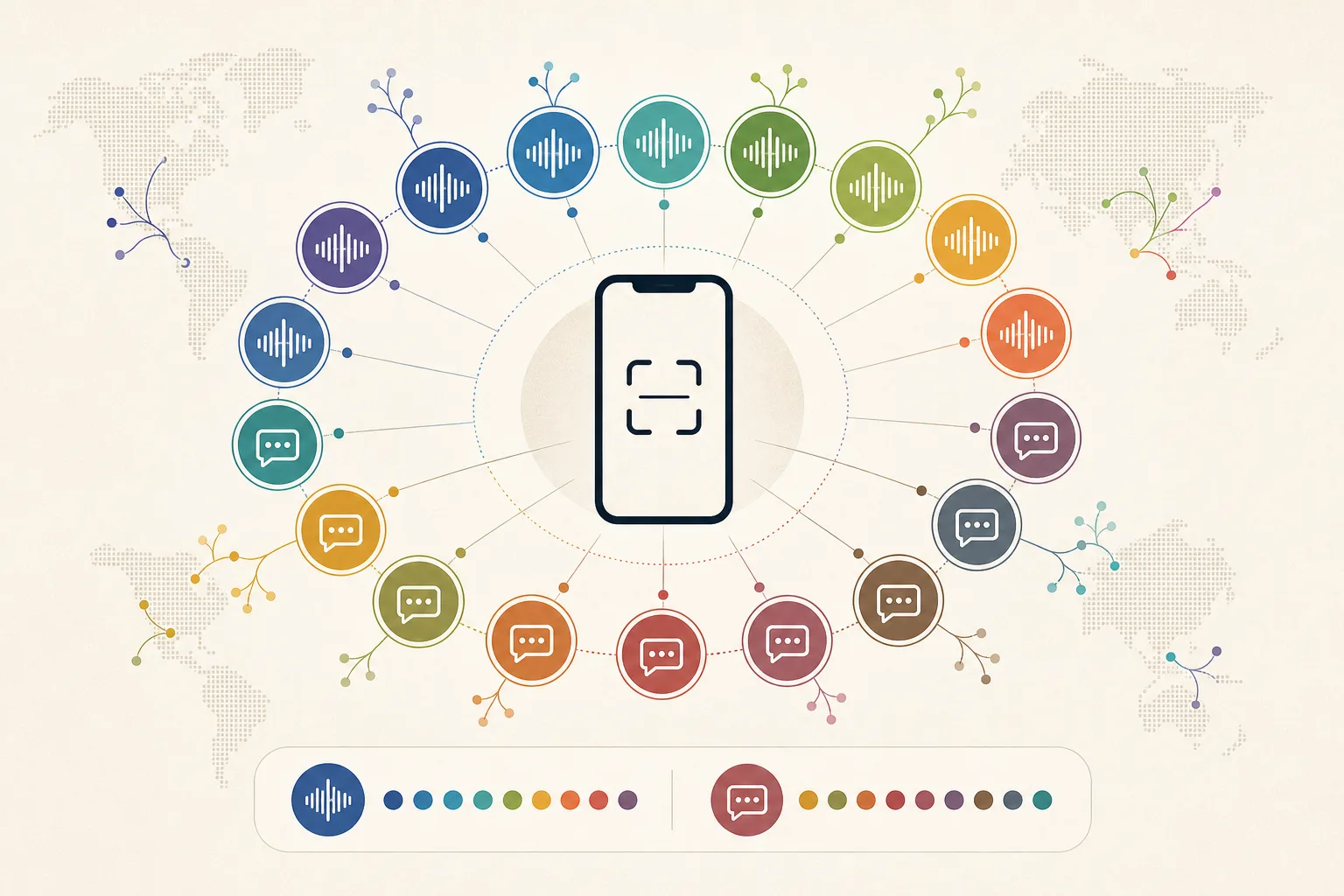
KissanAI currently supports 22 languages across two clear tiers: voice in 12, including English, and text in 10 more. Here is what that coverage does and does not mean.
The number 22 has a particular weight in Indian linguistic policy. It is the count of languages in the Eighth Schedule of the Constitution, and it appears often in technology claims as a simple feature: “supports 22 languages.”
We can now say 22 ourselves, but the number needs a coverage label beside it. KissanAI currently supports voice interaction in 12 languages, including English, and text interaction in 10 additional languages. Those are different levels of product support, and combining them into one number without that distinction would hide the work that remains.
What changed since launch
At launch, KissanGPT supported English plus nine Indic languages:
- English
- Hindi
- Marathi
- Gujarati
- Kannada
- Tamil
- Telugu
- Punjabi
- Bengali
- Malayalam
Odia and Assamese were not in that launch set. They were added later as the voice layer expanded.
The current voice-supported set is:
- English
- हिंदी
- मराठी
- ગુજરાતી
- ಕನ್ನಡ
- தமிழ்
- తెలుగు
- ਪੰਜਾਬੀ
- বাংলা
- മലയാളം
- ଓଡ଼ିଆ
- অসমীয়া
Ten additional languages are supported through text. That makes 22 supported languages in total, with the interaction mode stated separately instead of implying that every language has identical speech recognition and speech synthesis coverage.
Language is not the same as dialect
A language name is an administrative category. A farmer speaks a regional form of that language, often with crop, trade, and district vocabulary that does not appear in a standard dictionary.
Marathi is a useful example. Standard Marathi, Vidarbhi Marathi, Khandeshi Marathi, and Konkani-influenced Marathi can differ in the words used for an operation, a pest, or a crop stage. A farmer in Vidarbha may describe cotton with vocabulary that sounds unfamiliar to a speaker trained on formal Pune Marathi. The sentence can be valid Marathi and still be missed by a system trained mainly on news or textbook language.
That is why the language layer cannot stop at translation. It needs regional retrieval, vocabulary collected from real conversations, and enough context to understand what a word means for this crop in this district.
Text support is not voice support
Text support means the system can receive and produce written language. Voice support adds two more layers: recognizing spoken input and generating a useful spoken response.
Both layers have to handle code-switching, regional pronunciation, farm vocabulary, background noise, and imperfect phone audio. The same language can perform differently across regions and use cases. A clean studio sentence and a farmer speaking beside a running pump are not the same input.
This is why we now describe coverage in tiers. Twelve languages have the voice path. Ten more have the text path. The work to expand a text-supported language into voice is not a translation task; it is a product and evaluation task of its own.
Vocabulary has to connect to a taxonomy
Crop names change across languages. Bhindi in Hindi is vendakkai in Tamil, bhinda in Gujarati, and bendekai in Kannada. Mapping those words to the same crop is the straightforward part.
The harder cases are regional terms that have no clean one-word translation. A spoken term may refer to a pest at a particular life stage on one crop, while the same term in a neighboring district points to something different. Meaning comes from the language, location, crop, and conversation together.
The same problem appears in disease names, soil descriptions, irrigation terms, government schemes, and the colloquial names farmers use for agricultural products. A glossary can translate words. A regional taxonomy connects those words to the agricultural entity the system should retrieve.
Support is a maintenance commitment
“We support Tamil” is not the same claim as “we understand every farmer speaking Tamil in every crop context.” The first is a product-coverage statement. The second would require evidence across dialects, regions, crops, and audio conditions.
Language support has to be maintained with live feedback. New product names enter local speech. Government scheme names change. A term that works in one district can fail in the next. We review languages according to real usage, field feedback, and the gaps visible in conversations, then update vocabulary and retrieval context where the volume and risk justify it.
Dealer and field channels are often the fastest warning system. If farmers repeat a question because the assistant missed the local phrasing, or if an answer suddenly sounds like a textbook, that is a product signal even before it becomes a benchmark number.
Five questions behind the number
The useful follow-up questions are:
- Which languages support text?
- Which languages support voice in both directions?
- Which regions and dialects have been tested?
- How is crop and product vocabulary connected across languages?
- When was the language last reviewed against real usage?
On our own pages, the number should therefore appear as 12 voice-supported languages plus 10 text-supported languages. If a language moves from text to voice, the label changes only after the speech path has been tested against real usage.
Sources
- KissanAI language coverage · KissanAI KissanAI