The visibility gap nobody talks about
Agribusinesses cannot see what is happening at the farmer level. Farmers cannot see what agribusinesses know. The wedge that closes that distance is operational intelligence, the part of agricultural AI nobody is shouting about.
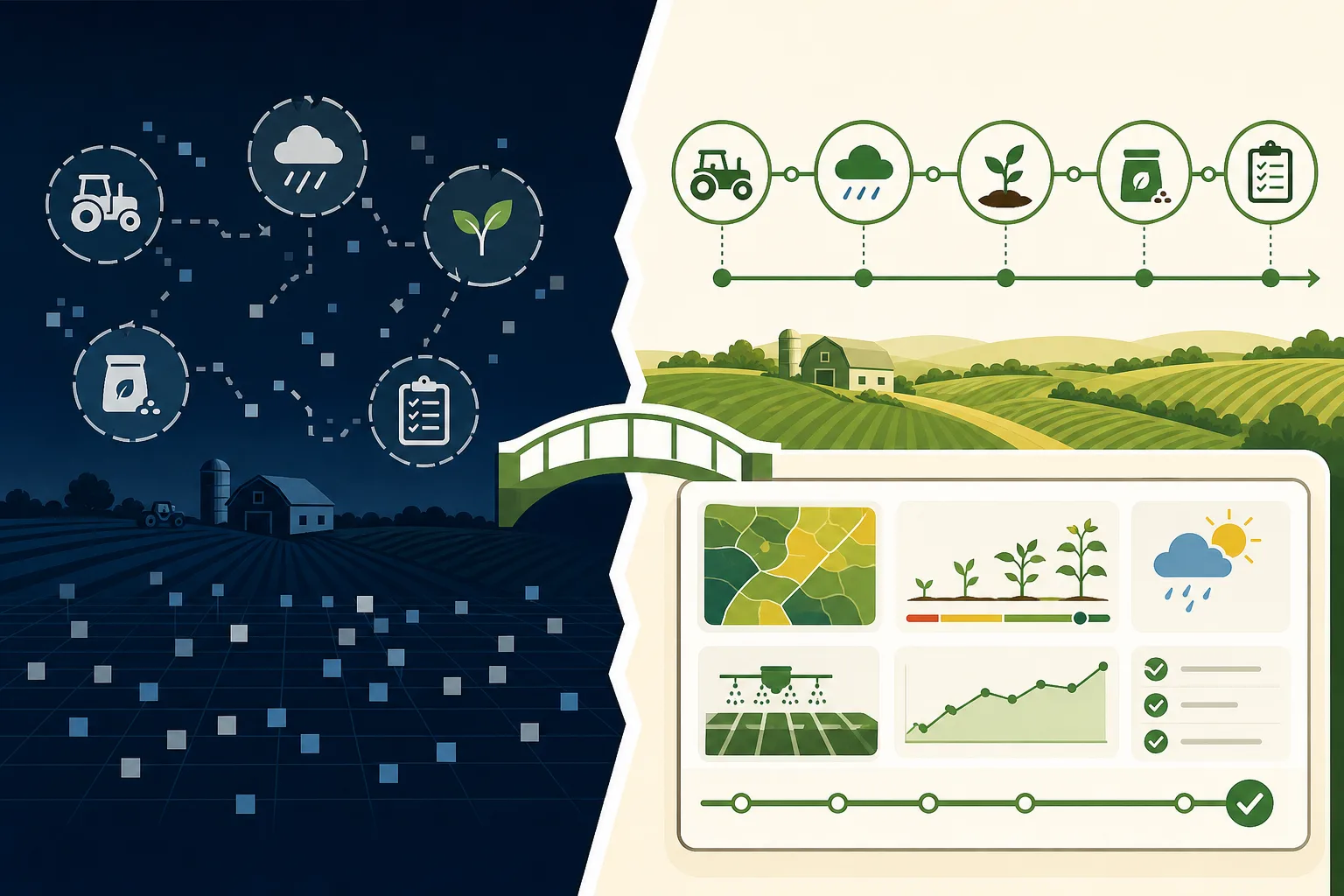
How much of the farmer’s reality does an agribusiness actually see? A seed company, an agrochemical, a fertiliser firm, a tractor manufacturer: these enterprises have a thousand or ten thousand or a hundred thousand farmer relationships, and what they see of them is the SKU sold through a distributor. They do not see the field where the SKU went. They do not see the outcome it produced there, or the decision the farmer made the day before buying, or the question asked at the retailer counter that influenced which product the retailer pulled off the shelf. By the time they see anything, it is a quarterly aggregate that has been smoothed and averaged and lagged by months.
The farmer lives inside the mirror image of the same gap. The farmer is making decisions every day with the information they have, and that information stops roughly at the village boundary: they cannot see the market price trend building two states away, or the pest pressure their neighbour saw last week, or the new seed variety that an agronomist three districts over thinks would work better in their soil. They are reasoning with the slice of the world they can directly observe, in real time, under operational pressure.
That distance is built into how agriculture is organised. It also explains why a farmer assistant can be useful to both the farmer and the business deploying it.
What I mean by operational intelligence
The phrase shows up a lot in marketing, so let me be specific.
When an agribusiness deploys a farmer-facing AI assistant (voice, multilingual, integrated into their existing channels) and that assistant becomes the daily companion for a meaningful slice of their farmer base, two things start happening simultaneously.
On the farmer side, the assistant gives the farmer access to information they would not otherwise have. The market price moving. The pest the neighbour just reported. The agronomy advice an expert would have given if the expert had been available. The compliance constraints on the input the farmer was about to apply. This is the farmer-side closing of the gap. It is what the user sees as the value of the product.
On the agribusiness side, the assistant produces a real-time, anonymised, aggregated stream of farmer-level signals. Which products are being asked about. Which regions are showing rising demand. Which questions farmers are asking that the agribusiness’s catalogue is not answering. Which agronomic concerns are spiking ahead of seasonal expectations. This is the operational intelligence layer. It is what the agribusiness sees as the value of the product.
Both views come from the same product. The farmer gets an answer; the agribusiness gets an aggregated view of what its farmer network is asking.
Why the agribusiness side is the harder pitch
Agribusinesses in 2025 are not short of data products. They are short of data products that actually integrate into their operations rather than landing as a slide deck on a director’s desk.
The instinct in the AI vendor space has been to sell aggregate analytics. Quarterly farmer-sentiment reports. Heat maps of product adoption. AI-generated insight decks. These products are bought and they are mostly not used. They generate a dashboard that someone looks at once and then forgets about. They do not change the next operating decision.
What changes the next operating decision is real-time signal that arrives in the operator’s existing workflow. When a brand manager is planning a regional outreach campaign for the next sowing season, they want to see which questions farmers in that region were asking the assistant last month, directly, in their existing planning meeting, not in a quarterly report PDF. When a compliance officer is reviewing recommendations going out under the brand’s name, they want to see those recommendations as they’re being made, not after the season.
The operational intelligence layer is operational because it integrates into operations. The instinct to sell it as a separate analytics product is the instinct to sell it badly.
Why the farmer side is the harder build
The farmer side looks like the easy part (just build a chatbot, after all) but it is the harder build by a significant margin.
A useful farmer-facing assistant has to operate in the farmer’s language, on the device the farmer already owns, on the connection the farmer actually has, with answers that are agronomically correct, regionally appropriate, regulatorily compliant, brand-aligned with the deploying business, and delivered at a latency that does not break the conversation. Every one of those constraints is non-trivial. Stacking them is what takes years.
If any of those constraints fails, the farmer disengages. A chatbot that requires literacy shuts out a large share of the market before it says a word. One that stumbles on the regional dialect loses the farmers who tried it once and felt talked past. One that takes eight seconds to respond loses them to plain attention drift. And one that recommends a product the farmer’s state has banned destroys trust in a single interaction and never recovers it.
The hard part is handling all of these constraints at once, and most AI vendors entering agriculture underestimate it. Most products in the space fail not because the model is wrong but because the deployment is wrong.
The product we built for the gap
The wedge our platform work pushes through is exactly this: voice-first, multilingual, regionally aware, and agronomy-grounded on the farmer side; real-time, integration-ready, and anonymised but rich on the agribusiness side; both ends of the same deployment.
The reason we have spent these years on the corpus work, the model work, the voice pipeline, the regulator integration, the regional dialect coverage, is that all of it was necessary for a useful product on both sides of the gap. We could have shipped half of it sooner and harder. We would have shipped a chatbot, and the visibility gap would have stayed open.
The next year is about scaling the platform across more agribusiness deployments and watching which operating decisions actually change. We will write about specific examples when the agribusinesses give us permission. In the pilots, teams that have used the assistant for a season enter the second season with signals they did not have before. We want to see whether that pattern holds at larger scale.
The test is simple enough to state. Does the farmer get a better answer at the moment of decision, and does the agribusiness learn something it can use before the quarter is over? If either side gets only another dashboard, we have missed the gap.
Sources
- KissanAI Launches Dhenu2 AI to Empower Farmers with Real-World Insights · Analytics India Magazine (24 Oct 2024) News